Pages

Thursday, May 19, 2011

market update May 19

Starting this weekend we will be outdoors at City Market on 104th Street as well as our usual, albeit temporary, spot at Old Strathcona Farmers Market. This will be our first weekend with two major markets on the same day so I have a lot of milling and packaging to take care of today and tomorrow.
Gretta and I at Old Strathcona Farmers Market

The Old Strathcona Market continues to amaze me with activity and the excitement of the customers. I love this market! Lots of great people with great discussions. We are doing very well at this market and I am enjoying being there very much. The atmosphere of the market every Saturday is contagious.

This Saturday, City Market is outdoors on 104th Street for the first time this year. I have been told how busy this market is and I will get to experience it first hand in two days. I need to go get our new market tent today!

Tuesday, May 17, 2011

spring work

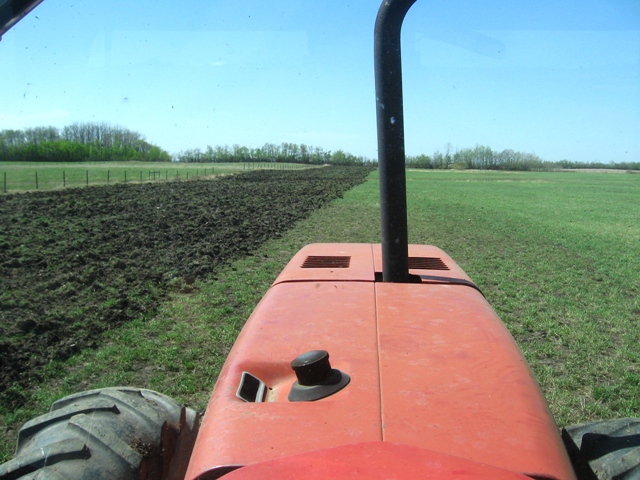
Very busy trying to get caught up with the spring tillage. Most of the fields were tilled last fall so they are pretty much ready to go for seeding after a quick shallow till with the disc or vibra-chisel and harrows. The home piece though was pasture until yesterday so I spent the entire day breaking the pasture trying to get it ready for seeding. The front part of the pasture was broke several days ago and I've been over it a few passes with the chisel plow and harrows. It takes a lot of work to get sod into seed bed. 


With spring tillage comes break downs. Nothing awful so far this year but the inside dual on the 2+2 developed a leak and I needed Kenny's Tire from Morinville to come out to the farm to help switch some tires around to get me going again. I don't have the $700 to spend on a new tire right now so I just went with a tire swap on the rims and now have single wheels on the front and duals on the back. As I write this though I know that the front tire on the 766 is flat...another few hours getting that fixed...


On a fun note, my son Garreth had his first solo run with the tractor and cultivator! He is 13 now and I was driving tractors and equipment on a limited basis by his age. He did really really well and after some training was doing everything just right. So I had him stop and let me out and he spent the next hour on his own with my close supervision. I trust him in emergency situations, he has a very level head and doesn't seem to ever get flustered. He'll be a great help around the farm in the few years to follow until he heads out to start his own life. I will enjoy our time farming together while it lasts.

Friday, May 13, 2011

sold the cows

This spring has been a very trying time for us. Having just built and relocated our home and farm...starting our flour business...being laid off from the off-farm job...jeesh what else can I pile on? One of the things that we have been half-heartedly kicking around is the idea of selling off all the cows (as opposed to expanding the herd). I adore my cows. The thought of selling them killed me inside and I wouldn't have anything to do with it. However...sitting on my tractor this spring for hours on end has given me the chance I needed to really think about it objectively. The return per acre of our little herd is about $70/acre when we sell the beef. The return on grain is approximately $250/acre. So, it came down to a simple question of how much am I willing to pay to have cows around the farm? The answer, once I thought about it seriously, was obvious and with one phone call to our neighbour our cows were sold. He had been admiring them all winter and it was an easy sell.

We will keep the two steers that we have already sold via the csa. But come November when they are processed that will be the last bovines on our farm for the time being.

I will miss them surely...but, grains are our focus around here and grains is what we are going to do. No more baling feed. No more winter days of fixing frozen stock waterers. No more stuck tractors in the snow and fretting about whether or not I secured enough hay for the winter. No more holidays cut short by the thoughts of poor relatives at home feeding and watering our animals. But, also, no more Missy and Miley, Henny and Hanna, Skipper and the little ones each spring. I guess I'll have to look at them from across the fence at the neighbours place. Every now and then I can walk over and give out some neck scratches.

Wednesday, May 11, 2011

focaccia bread with our Soft White Wheat Flour!

Blogger and cook extraordinaire Get Cooking's Kathryn made a wonderful looking Focaccia Bread with our white wheat flour. This is not white flour, but a flour milled from Soft White Wheat. Extremely tasty, especially when milled fresh...this variety of whole wheat flour is definitely our most flavourful flour. It is not as high in protein as our Hard Red Spring Wheat flour so is probably not your best bet for traditional loaves of bread, but it makes wonderful cakes, cookies, muffins and obviously....Focaccia!

Sunday, May 01, 2011

crepes with strawberry maple sauce

I made some lovely crepes this morning with our Soft White Wheat flour. It was a little trickier to make crepes using an entire grain flour, but I got it working and they tasted amazing if I do say so myself.

Here's what I did:
Crepe Recipe:
1 cup soft white wheat flour (you can sift it if you prefer)
1 cup milk
2 eggs
1/2 tsp salt
1/4 cup melted butter or less if you prefer

Just mix all the ingredients. It should be a runny consistency, unlike pancake batter which is thick. Heat the frying pan to medium low and add some butter. When the griddle is hot apply the batter and then tilt the frying pan around to spread the batter thinly. Let the crepe cook until the edges appear cooked and then flip it and brown the other side. Easy!

Strawberry Maple Sauce
3 cups frozen organic strawberries
1/2 - 1 cup organic maple syrup
Sugar to taste (if you like)
1/2 cup water

Boil the strawberries, water and sugar until the berries are soft. Mash them with a fork and reduce the sauce until you get the thickness you prefer. Add the Maple Syrup. Done. Easy!

We filled the crepes with a spoon full of organic Strawberry Yogurt and rolled the crepes on the plates and then drizzled (ok, poured) the strawberry maple sauce over the top. You could also add some icing sugar for fancy decoration, but we couldn't wait to do that. We also cooked up some Side Pork from Irvings Farm Fresh...yummm!

desiccation

Why do so many people look at me as though I am crazy or some sort of conspiracy theorist when I mention the fact that so many crops are now desiccated with herbicide immediately prior to harvest? I actually got in a bit of an argument with a person yesterday who didn't believe me? Albeit, I had another lady bring up the fact herself...whew...ok, I am not crazy. Glad to hear it.

For all those who do not believe me that is just too bad. It is a fact. It is not an urban legend. Instead of swathing wheat, most conventional farmers now spray their wheat crops several days prior to combining. In this way the wheat can dry down all at once and still stay standing to avoid any moisture damage that can occur in a swath.

In the states and drier, warmer climates, desiccation is not necessary. The growing season is long enough to simply allow the wheat to die off and dry naturally. Up here in Canada, that is not practical so you see tracks in the nearly mature wheat that indicate a sprayer has been in action.

You don't often actually see the farmer spraying. I can't help but think that this is on purpose. I have seen the spraying many times though and I know for a fact that it is now an extremely common practice. I challenge all of you to observe for yourself this fall. When I see it again next fall I will video it for you all to see for yourself. In the meantime, have a look at Kevin's video interview of our farm from last summer where he shows some of the tracks.

FROM LOCAL FARMS - Gold Forest Grains from Kevin Kossowan on Vimeo.

Friday, April 29, 2011

market update

I just thought I would post a bit of an update here on the blog. We have been tweeting and facebooking a bit more lately and the blog has been suffering a bit of neglect I am afraid. 

Tomorrow is the first day for us at The Old Strathcona Farmers Market! For those who don't know, this market is huge in Edmonton and is our only large, year-round market. St. Albert and City Market are perhaps bigger in the summer months. So, now we are marketing our flour products at Old Strathcona and City Market on 104th on Saturdays. This should keep us busy milling and packaging flour for a day or two during the week on top of our other customers' orders. 

Currently at market we are carrying: Hard Red Spring Wheat flour, Soft White Wheat Flour, Golden Flax, Rye flour, Wheat/Rye Pancake Mix and Wheat Berries.

At any rate, we really appreciate feedback from our customers. Please log in and comment with your recipes and comments if you have had the chance to purchase flour from us or if you have any questions about our farm or our flour! 

Thursday, April 21, 2011

girls! girls! girls!

Meet the girls. My favorite bovine girls...Missy and Miley. These are our two purebred Galloway cows. Actually, Miley is a heifer...a girl cow who hasn't had a calf yet. She will this year though. Miley is on the left.

Missy has had three calves now. She always throws docile calves that gain well and are healthy. Miley is Missy's second calf. Her calf last year is a steer that we will process this coming fall.

As you can see, Galloways are quite hairy. This sure helps in our climate where the extra insulation allows them to eat far less and still gain weight. Cindy came across some publication just the other night that she read out loud to me. It said that in coat density, the Galloway finished second only to Bison. Galloway are an ancient breed that originated in the highlands of Great Britain/Scotland. There are references to the sweetness of the meat from the 1500's.

They are so gentle and friendly. Always welcoming a neck scratch from their favorite local farmer.

Miley flashing us her 'good side'. What a cutie.

Wednesday, April 20, 2011

farmer cable tv

I built myself a digital antenna recently. Actually, I built it right around Christmas. I found the recipe on Youtube and built it in an afternoon with wire coat hangers and a piece of lumber. I just wanted to see if it would work at picking up HDtv from the stations in Edmonton that broadcast digitally in HD. It worked! At first we could only get CityTV in HD, but it was amazing. For those who get to watch tv in HD you will know how amazing the picture quality is...it truly is striking to watch HD programming.

You can see in the picture how easy it is to build.

Now these type of antennas work with line-of-sight broadcast signals so it is best to get them up on a tower of some sort and definitely outdoors. Our antenna is simply propped up in the living room window and we still get two digitial hd channels...for free. Here is a link to tv stations and their digital status in Alberta. 

Anyways, this is the television package that we choose to afford. It isn't much, but we get the news and Funniest Home Videos, etc. and now we get to watch Hockey Night in Canada in HD. Just curious about how many people who say that they cannot afford our flour (which is still priced below grocery store prices) manage to afford a satellite/cable bill of around $60+ a month? Just curious.

Wednesday, April 13, 2011

odd jobs

Lately, since being laid off from my off-farm job I have had to look for work elsewhere. It has been an adventure to say the least. Not many people want to hire someone who needs to be able to leave work for days on end to seed, or mill flour, or haul grain or whatever else is occurring on the farm. I need a job with flexibility and part-time hours that pays well. I have taken a couple consulting jobs helping other companies to achieve their own safety program. I have also offered to help my brother-in-law Darel with his screw pile business. In the spare time, I have spent a few hours here and there trying to get the interior of the house finished. Cindy has taken a full-time job in the city for the first time since we've been together.

Of course, more important than all of the above has been the efforts to grow the flour business. That is where my passion lies...the farm. Last night I had a meeting to present my flour and grain products to The Old Strathcona Farmers Market jurors. That was interesting, but no indication whatsoever if I was successful in getting into the grand ole market. We'll see.

While none of this crap is terribly bad, we are not in danger of losing our home for instance, it has given me the opportunity to realize the importance of making the farm work financially or simply getting out of it altogether at some point in the future. Trust me, getting out of farming is the last thing I will contemplate. Still, it has crossed our minds that if our farm venture doesn't work it will mean downsizing to hobby farm status at best while I get permanent full-time work off-farm.

Of course, all of this thinking gets me thinking about food and prices and sustainable agriculture. Driving through St. Albert today I saw a sign in front of the McGavins Bakery that said in big bold lettering CHEAP CHEAP CHEAP BREAD 10 for $12. That sign is the exact reason that agriculture and especially family-farm type agriculture is in serious trouble in North America. I would venture a guess that nowhere in Europe would a sign like this exist...I could be wrong. If you haven't had a chance, watch the Movie "Broken Limbs". It is a documentary on apple farming in Washington state. Incredibly inspiring to watch, cleverly portrayed and completely insightful. I am embarrassed by that sign in St. Albert. I continue to feel badly that we live in a place where people in general look for the cheapest food as opposed to the best food. I am so glad for the customers that chose to support our little farm at City Market and Alberta Avenue Market and the bakeries that buy from us.

In the meantime, we happily struggle ahead with our plan to provide incredibly fresh flour at a reasonable price to as many people as possible. I hope that it is a win-win proposition.

Friday, April 08, 2011

yorkshire pudding recipes baby!

My absolute favorite baking project...even better than pancakes, is yorkshire's from a smoky hot oven. Crisp, golden brown and savory I can't think of anything that tastes better when drizzled with a nice roast gravy. But...don't forget to keep some extras in the fridge and then in the morning cut them open, fill with whipped cream and then sprinkle with powdered sugar....oh my.

Here is where I got my recipe for yorkshires. I have been using this recipe for a couple years now. It is the first one...Maggie's. Yorkshire Pudding Recipe 
It is from the Canada B&B Hosts website.

I have found that the key to puffy Yorkshire's is to make sure that the ingredients are indeed room temperature. Really get that muffin tin hot too. So hot that it is smoky and the batter sizzles and spatters as you pour it in. Get the batter in the tins as quick as you can and shut the oven door...don't peek until they're done...keep the oven hot.

Ok, so here's the plan...go to City Market or Strathcona Market on Saturday. Buy a nice pork roast from Serben's Free Range or First Nature Farms and some Flour from us. Then go get some potatoes. Oh yes, if you need some really fresh and completely flavourful cooking oil, go see Mighty Trio Organics. Then, after a wonderful afternoon at the farmers market you will have your Sunday roast pork dinner all lined up. I can taste it now.

Enjoy!!!

slow week turnaround

It has been a rather slow week so far at the markets. Last Saturday at City Market was the slowest yet for our sales and then again this Thursday at Alberta Avenue. I figured that the warmer weather would have folks out and about, and they probably are...just not at an indoor farmers market. Can't say as I blame you guys. It sure is nice to be outside on a sunny and warm afternoon after such a brutal winter.

Anyways, we are still at the markets come hell or sunny spring afternoons so please do take some time to come indoors tomorrow at City Hall for a visit. More and more vendors every week so there is no shortage of fresh local food! Hopefully we will see you all there!

Also, you can now 'like' us on Facebook!

Friday, April 01, 2011

RIP Jedi

There is nothing worse about farming, or life in general, than the feeling of hopelessness and the realization that you need to put an animal down. I have had to do this several times throughout my life, as I am sure most people have. The difference with being on a farm is that usually the farmer is the one who has to perform the solemn act. It is almost never worth paying a vet and the rifle is much quicker and more humane than the stress of needles and strangers poking and prodding. The feeling I get before having to perform this duty is never anything that I would wish on anyone...worst enemies included. I am not ashamed to admit that it makes me cry. I suppose the fact that it makes me feel so bad is good in a way...I am not used to it and I don't do it often enough to make me callous of the responsibility.

This morning I had to euthanize our Llama, Jedi. He had been down for three days and couldn't get up. We kept him as comfortable as possible but there was something dreadfully wrong with his back or hips. He was old and I was completely confident that there was nothing more that could be done. With a mouth full of tasty grains he got to see one last glorious sunrise early this morning and then his suffering was over.

Jedi was a good llama and we have many fond memories of him. As a basically useless animal in almost all aspects of normal farm operations Jedi found his niche babysitting. We originally bought Jedi as a pack animal. Cindy and I had dreams of packing in the mountains with our string of llamas and we got fairly serious about the training and even went so far as to acquire the llama packs. Cindy would very often saddle up the llamas and go for long walks around our old property. Winding trails through the woods and hills, string of llamas behind her, Cindy has many happy memories with the 'boys'.

Sadly, we never went on our dream holiday with them. I don't know why...just didn't. We ended up selling all of them except for Jedi. He was our favorite and we thought he should hang out with us for the rest of his days.

As I mentioned earlier, Jedi's best days were spent diligently watching over the baby critters of all types. He was especially effective with the lambs when we had sheep. They would drive him nuts climbing all over him and on more than one occasion we would look out to a lamb sleeping comfortably on his back as he laid chewing his cud. Lately though Jedi's responsibility was the calves. He would pace feverishly, humming noisily whenever a calf would escape. We always knew right where to look! As the calves grew, Jedi would become their unwilling playmate. I am sure they drove him crazy, but he never complained.

He never spit on anyone. He always reluctantly put up with our petting and I will miss his worried humming this summer when a calf squeezes through the barbwire.

Jedi was a good llama and a valued animal on our farm. I will miss him.

Wednesday, March 30, 2011

lessons learned?

This past winter (and I use the word 'past' with hesitation) has been very trying for Cindy and I. While there have been many positives with the farm business, there have been just as many setbacks and hardships. I certainly want to avoid complaining. Our children are healthy. We have a warm bed to sleep in and food to eat. Our entire farm has not been washed away in horrifying fashion as so many were in Japan. Those events that we watched in awe from so far away have served to remind me that things could be so much worse. 

Still though the hardships we've faced were stressful enough and have helped to remind me that I need to be more pro-active and work harder still to be prepared. The snow this year was just too much to handle and wrecked equipment and made it difficult if not impossible to perform farming business at certain times. I have not been able to get to the grain bins for most of the winter. The cost to repeatedly bring in the snow removal company would have simply been too great. The strong winds also blew in under the eaves of the steel grain bins and I had to shovel snow off the piles of grain. Of course, a lot of grain got shoveled out along with the snow. Lesson Learned...plant more fast growing trees and stuff the gaps with something that vents but keeps snow out and figure out better snow removal equipment. 

Even feeding the cattle has been hard. For most of the winter I was able to get the tractor out to the bale pile in the middle of the field. We have a rather large chore tractor with dual tires on the back, even so I had to borrow the neighbour's small tractor with attached snowblower to make a path to the bales. Of course, a week later the wind would blow for 4 days and that path would be rendered invisible. I just couldn't bring myself to keep borrowing equipment so I did my best to pack the snow with the tractor to get back and forth to the bales. Finally about a week ago the tractor became stuck and there is no way to get it out until the snow melts. So, that means feeding 9 cattle by hand from stacked round bales twice a day...not fun. Lesson Learned...stack the bales close to the house and keep the cattle close too (or get rid of the cattle).

This has been a tough winter. Our new property is so vulnerable to wind and bad weather. We need to focus on improving our land through the planting of as many trees as we can possibly handle. I am completely embarrassed for the previous generations of landowners in the area who actually went along with plans to eliminate trees from the ditches and fencerows to allow more cultivatable land. Supposedly our area was treed quite nicely prior to the 70's. I was told this by a family we know that have owned their farm for 100 years. Now I will have to try to fix that as best I can on our own property. 

We have so much work ahead of us to build proper out-buildings to shelter bags of grain and equipment. To plant trees and care for them. To gravel the yard and build or purchase proper snow removal equipment. To landscape and beautify our farm. Most of this work I look at as a challenge and I look forward to. But there is just so much to do and that is a little daunting. 

The weather now holds the promise of Spring. The snow is receding and with that comes renewed energy and optimism. We are so encouraged with all the new friends we are meeting with the flour business and that encourages us even more. See you at market tomorrow at Alberta Ave.!

Monday, March 28, 2011

wheat beer - guest post by Mark Senior

Making Wheat Malt


I recently got a 50 lb bag of wheat from John, with the idea to experiment making my own malt for use in homebrewing beer.

The short version of how this works is that you get the grain to begin sprouting, during which it produces enzymes that make the stored energy in the seeds available to the growing plant. Basically sprouting converts the starch to sugar.  Once the full amount of enzymes is produced, but before the growing seedling has had a chance to consume much of that stored energy, you stop the process by dehydrating the seeds under moderate heat (too hot and the enzymes break down).  When you're ready to brew, you'll set up conditions for the enzymes to convert the starch into sugar for the brewing yeast to consume.


The long version of how it works can be found in a few places online. I referred mainly to this page
Most of what I found online is specific to malting barley, but I found a few references to differences in approach when you're dealing with wheat (mainly, wheat sprouts quicker, and there is an extra step with malted barley - a higher temperature kilning after it's dried).

I started with a fairly small batch of grain for my initial trial, about 2.5 kg.

Step One - Soaking

The first thing you want to do is to soak the grain for a 6-8 hours, then drain it and let it breathe for about as long, and then soak it again.  As I was working around other things in my life, like work and sleep, I ended up soaking for about 8 hours, letting it breathe for about 9, then soaking for 5.

I use a lot of 20L food-grade plastic pails in brewing, and I have one that I've fitted a spigot to for sparging grain with.  I grabbed an extra pail, drilled a few dozen small holes in the bottom, and put it inside the pail with a spigot - this gave me a nice container for soaking the grain, that was easy to drain.

When I initially filled the pail with water and stirred the grain up, there was practically no chaff - the grain seems very clean.  I had thought I might have to pour out that first batch of water to get rid of chaff, and soak in a fresh batch, but I just left the first batch.

Step Two - Sprouting

The next step is to keep the grains evenly moise, and let them sprout until they are what's known as 'fully converted' - at this stage, the acrospire (the beginning sprout that will turn into a stalk of grass) is about 3/4 the length of the seed in most of the grains.  When malting barley, the acrospire is inside the hull, so you have to cut open a sample of seeds to see how it's progressing, but wheat has no hull, so you can just grab a handful of grain and look.

The goal is to get even conversion - you don't want too many of your grains to be underconverted (less than the full enzyme production) or overconverted (much of the starch used up).  So, you want to stir the grains as regularly as you can manage, to keep the temperature and
humidity that the grains are exposed to consistent.  I managed about twice a day.

By 24 hours after the final soak, most of the grains had a little
white bulge at one end, where the acrospire and roots were beginning to form.

By 36 hours, most of the grains had visible rootlets 1/4 or more the length of the grains.

At 72 hours, there were acrospires on most of the grains.  I figure about 90% had at least some acrospire, with maybe 2/3 of those (so, 60% of the total) in the neighbourhood of 2/3 the length of the grain. The grain also felt like it might be drying out a bit, so I rinsed it briefly with fresh water - letting it soak just about 10 minutes before draining it again.

Step Three - Drying

At 96 hours or so after the end of the soak, I decided it was time to stop the sprouting.

I weighed the grain at this point, and it was  around 3.75 kilos, about 1.5 times the starting weight.

I spread the grain out on cookie sheets and baking trays, and put them in the oven.  It turns out to be a good thing I only sprouted this small batch of grain for my initial test - it completely filled my
oven as it was.


The Oven Setup


At its lowest setting, my oven seems to swing between about 55 and 70 C - too hot for drying grain; the enzymes would be broken down (it might be useful for making crystal malt, but that's another experiment for another time).  I settled on turning on the oven light and putting a couple of little 25 W reading lamps in the oven.  This produced a steady temperature around 40 C, which is about right for this purpose.

The drying took around 2 1/2 days.  Ideally you want lots of air circulation, which my oven does not provide; if I had a food dehydrator, or one of those ovens with a convection fan, it probably
would have gone faster.  Next time around, I probably will see if I can borrow a dehydrator from a friend - as I keep going with this, I'll want an approach that dries the grain down quicker, and doesn't put the oven out of commission for days on end.

After drying was complete, the grain weighed around 2.2 kg, around 90% of its starting weight (that's including a bit of a fudge factor for the wheat I kept eating throughout the process to see how its taste and texture were changing).

You want to avoid brewing with grains that have the rootlets still on they apparently contain quite a bit of protein, which can cause your beer to be very cloudy, without contributing anything much to the taste.  I put the grains in a sieve, a handful at a time, and rubbed them to sift out most of the rootlets.  Even with this small amount of grain it was a pretty tedious process - next time, I will try using an old window screen for this part.


Mark...hard at work


When dealing with barley, there's another step after drying, kilning, in which the grain is heated to a higher temperature for a few hours, to give it its desired colour and flavour.  This can range from four or five hours at 70 C for a pale malt, to much higher temperatures for dark chocolate malts.  From what I found online, it seems this step is not typically used for wheat malt, and I didn't do it.

Step Four - Beer

I've made a very small test batch of all-wheat beer, which I'll write about another time - maybe once it's ready to drink.

Hopefully Mark will post some results of his beer project and perhaps a picture or two. I would love to see the finished product from another use for our wheat!

Saturday, March 26, 2011

why conventional agriculture sucks

A few examples of how conventional agriculture will not only fail to feed us all, it will contribute to our troubles. Our oceans are dying. Our pollinator populations are in desperate decline and chicken production is contributing to our inability to fight off disease illness through the use of anti-biotics. These are just snippets of information on topics that I think are most important for people to contemplate. These three subjects alone have the potential to cause a serious devastation of our own human population.

Every now and then I get tired of tweets and posts from proponents of conventional agriculture with their head in the sand. Follow the money people. Do your own research and please continue to vote with your food choices.

The Big Three arguments against conventional agriculture not in any particular order (and there's a lot more than three by the way).

1) Hypoxia in the Gulf of Mexico from ground water run off in the agricultural regions of the Mississippi River drainages.


From the website...http://co.water.usgs.gov/hypoxia/html/newpubs.html "The effect of nutrient loading from the Mississippi Basin on the areal extent of the Gulf of Mexico Hypoxic Zone is investigated using a dissolved oxygen model. Results suggest that a 30% reduction in nitrogen loads may not be sufficient to reduce the average size of the hypoxia zone to 5,000 km2."

from the website...http://www.sciencedaily.com/releases/2010/09/100927122225.htm In the summer of 2010 this dead zone in the Gulf spanned over 7,000 square miles."

2) Antibiotics in chicken production to render useless the world's known anti-biotics.

According to the recent Marketplace episode "Canadians are becoming increasingly resistant to antibiotics. As a result, people are getting sicker and are taking longer to get well. It is now not uncommon for people to be administered antibiotics through an IV because the usual drugs in pill form can't fight off their infections.
While we've all heard that over-prescription of antibiotics to people is one cause of the resistance, what many Canadians don't know is that another major cause is because the animals we eat are also given large amounts of antibiotics. And not just when they're sick: healthy animals can be fed antibiotics every day because it makes them grow bigger, faster."


From the website... http://www2.macleans.ca/2009/06/17/playing-chicken-with-antibiotics/ "Disturbing data from the Public Health Agency of Canada reveals that antibiotics such as cephalosporin used in chicken hatcheries across the country is causing human resistance to the medicines, according to a startling report in the Canadian Medical Association Journal today.

3) New pesticides directly related to mass Bee deaths. We all know how important pollinators are to our own survival as a species.

From the website...http://www.nzherald.co.nz/world/news/article.cfm?c_id=2&objectid=10701335 "A new generation of pesticides is making honeybees far more susceptible to disease and may be a clue to the mysterious colony collapses that have devastated bees around the world.

Yet this discovery has remained unpublished for nearly two years since it was made by the United States Department of Agriculture's Bee Research Laboratory."
http://www.tindakmalaysia.com/showthread.php/2037-Bees-Petition-to-Save-the-Bees-from-the-Global-Chemical-Companies..."increasingly, independent research has produced strong evidence blaming neonicotinoid pesticides. France, Italy, Slovenia and even Germany, where the main manufacturer Bayer is based, have banned one of these bee killers. But, Bayer continues to export its poison across the world "

I HATE having to write these posts. I see so many other people out there fighting against conventional, unsustainable agriculture, I just can't sit back and watch. Sorry.

organics can feed the world...stop wasting food!

This post isn't going to be quoting any studies that argue the point that organic agriculture can or cannot feed the world. But, it is going to point out one thing and that is the absolute disgrace that is our modern society's wasteful attitude towards food. Read this...http://www.good.is/post/the-u-s-wastes-40-percent-of-all-food-produced-per-year-how-about-we-stop-doing-that/

Also, have a look at Bruce's post if you want to see some serious potential waste. If Bruce wasn't there, all that food would go to the landfill!

Organic agriculture produces roughly the same amount of food as conventional does. There are many studies that are sponsored by Monsanto that would refute that I am sure but I chose to believe more reputable studies by people who actually want to know the truth instead of corporations that want to produce their own truth. But let's say, just for argument's sake, that it doesn't produce as much food. How about we set up a North American society that doesn't waste up to 40% of its food. I would suspect that if we could capture even half of that waste, we'd be doing just fine with whatever organics can produce and we'd have the added benefit of reducing all the chemical pollution that is jeopardizing our health and welfare.

Why I believe that small-scale, organic agriculture can indeed feed the world...
An added story that relates to sustainable agriculture from a new friend and market customer Nancy...On March 8, Dr. Olivier De Schutter, the United Nations Special Rapporteur on the right to food,released a reportarguing that the use of small-scale, diverse farming methods, which he calls "agroecology," can double agricultural production in poverty-stricken areas, increase the economic prospects of the inhabitants, and improve their local environment.  

Friday, March 25, 2011

whole wheat flour info.

By far I am getting positive response to our flour and grain products, but once in a while I get somebody come up to me and ask why their bread turns out "like a brick"? Each time I ask how they bake their bread the answer has been the same...bread machine. I don't think that it is possible to bake 100% whole wheat bread in a bread machine and have it turn out properly. Maybe someone could figure out a way to make it work and post their recipe?

I know that it is convenient to use a bread machine. We have one collecting dust in the back corner of the pantry. We used to use it all the time. But if you want the benefits of local, organic, whole wheat bread then it is probably worth 20 or so minutes to bake your loaf in the manner described below. Besides, it is good for your spirit to make your food with your hands (at least until you turn on the Kitchen Aid!). 

We have been telling folks how to bake 100% whole wheat bread in very simple terms. More liquid. More kneading. I found this quote from Wikipedia and it sums up what we have learned about whole wheat bread.

...it is possible to make a high-rising, light loaf of 100% whole wheat bread, so long as one increases the water content of the dough (the bran and germ in whole wheat absorb more water than plain white flour), kneads the dough for a longer period of time to develop the gluten adequately, and allows for a longer rise before shaping the dough. Some bakers let the dough rise twice before shaping. The addition of fats, such as butter or oil, and milk products (fresh milk, powdered milk, buttermilk, yogurt, etc.) can also greatly assist the rise.

Here is a pretty good youtube video that is relevant to our discussion here.

I don't bother with potato flour or orange juice and I get the exact same results that he does. I also don't let it rise twice although I am told by professional bakers that it is best to rise it twice. 

The Kitchen Aid mixer is invaluable for the bread in this video, but it is good physical exercise to just knead the old-fashioned way. I use the mixer and let it knead the dough for around 10-13 minutes. Let the dough get good and 'springy'. There are some other good tips in this video recipe that I want to try like the foil tenting and the braiding. 

Of course a much simpler way to enjoy our flour products is to purchase your bread from Prairie Mill Bread Co. or Treestone Bakery or Queen of Tarts! No matter how you eat our flour, we continue to thank you for supporting our little farm. We really appreciate all of your comments, questions and conversation too! 

Thursday, March 24, 2011

new products for this week

At Alberta Avenue Market tonight we will have a limited quantity of Wheat Bran available! We are playing around with the sifting of some of our products. We sifted some of the pancake mix.actually it was the Soft White Wheat Pasta and Pastry Flour. The byproduct of that sifting is wheat bran.  Rest assured that the whole grain flours are indeed still whole grain or as we like to say "entire grain". 250g packages $4

Also for Alberta Avenue and Saturday's City Market, we will have more of our pancake mix available. We have been receiving some great tweets about our pancake mix. People who purchased our limited quantity last weekend are really enjoying Gold Forest Grains pancakes! 1kg packages $8

Also, you might not recognize our table at the markets this week. We are getting fancy. Fancy new red plaid table cloths! We wanted to get more of a country type feel to our stand to better represent what we are all about...country, fresh, farm-milled whole grain flour.

Wednesday, March 23, 2011

markets this week

We are looking forward to the Alberta Avenue Market again this week. Last Thursday was the best market of the year there so far. It was great to see so many people enjoying such a tremendous market. We will have our usual lineup of flour products along with the new Pancake Mix.

City Market moves back upstairs to the main floor of City Hall on Saturday. This will be our third week at City Market and each week has been better attended than the last. Hopefully some spring weather will grace us and even more people will come visit us this weekend. Again, the Pancake Mix will be there along with freshly milled entire grain flour.

Hope to see you there!

you're killing me!

Whomever is in charge of this weather is looking to get a serious beatdown pretty quick. It is March 23rd for crying out loud.

We have not had a break from winter yet, I mean come on. Snow still accumulating...Ark building continues in preparation for spring flood situation....Beyond frustrating and I don't care but the next person who tries to interrupt my bellyaching by saying something like "well there's nothing you can do about it" is going to get poked in the eye. There IS something I can do about it...I can complain.

For a limited time, I am offering you all a way to feel better too. For very little money, you can comment below and vent all of your frustrations about our Edmonton weather. Come on...I know that there are more of us out there that just want to swear and kick something and complain about a 2 day blowing blizzard at the end of March. People without some form of farmers blood in them need not apply.

25,000 pound tractor 'stuck till it melts'...feeding by hand from now on!
Looking ahead to the long range forecast and I can see plus 9 next week? I'll believe it when I see it.

Monday, March 21, 2011

Seedy Sunday and Beyond the Supermarket

I just had such a great day yesterday. First, I stopped off at Alberta Avenue Community Hall to visit the Seedy Sunday festival. It was wonderful to see so many other people concerned about seed security and food safety. Also, just plain old gardening fun during a period of weather where Spring just doesn't want to arrive.

I made a bee-line over to see Lola Canola first. Patty was giving a talk about planting for pollinators. I couldn't stay to listen. Did anyone get a chance to hear her speak? I am sure it was entertaining and informative.

Next stop was to see Jim Ternier from Prairie Garden Seeds. I admire Jim's work and I've talked to him a few times about heritage grains. This was my first face to face with Jim and we got to chat about Kamut and Red Fife for a few minutes. I managed to buy the last pack of Red Fife and a packet of Medora Durum Wheat. Those were two good scores for my collection.

Jim Ternier from Prairie Garden Seeds


The real reason I was in the area though was to present and attend the Beyond the Supermarket event at the Nina Haggerty Centre for the Arts. This was a cafe style 'tradeshow' where customers and producers could intermingle and exchange ideas and present their businesses. I found it to be a tremendous venue to really connect with potential customers and other producers. I certainly appreciated the chance to be there and say a few words about our farm and heritage grains. It was attended almost to capacity and I suspect that next year the venue will be a little bigger. Still though it was very comfortable and cozy. It was very easy, and encouraged, to eavesdrop on conversations and learn about other businesses providing local food to Edmontonians.

The very best thing about yesterday though was meeting with all of my new friends and customers. I saw a tweet from Super_Su and I sure appreciate her support all the time. All of the conversations are so enjoyable...from talking with people who are planning their new self-sufficient lifestyles to bakers and restaurant professionals to small-holding future farmers...it was a very good day.

John

Friday, March 18, 2011

pancake mix

New for the market tomorrow will be GFG's Organic Pancake Mix! Made from our time tested recipe, this mix is made with a perfect blend of freshly milled Rye and Hard Red Spring Wheat. The ingredients are all Organic so all you have to do is add one egg, a cup and a half of milk and some oil.

These pancakes are our family favorite. You will be amazed with the flavour and aroma of fresh milled pancakes. Nobody in our house ever commented on the smell of pancakes until we started making these!

I only had time to mix up a small batch today so there will be limited quantities for the market tomorrow. If they sell well and we get good feedback we'll consider adding them to the products that we offer at all markets and outlets.

Thursday, March 17, 2011

this little pig went to market...

I am off to market! A happy time for sure. I really enjoy visiting with people and trying to make a go of our little farm. Each time I sell a package of flour I feel thankful and proud that I created something that somebody is now going to take home to nourish themselves and their family. It is a great feeling for sure.

Tonight is the Alberta Avenue Market from 5-8 pm on 118th Ave and 93rd St.

Saturday is City Market at City Hall downtown Edmonton. This week the market is in the parkade Level 1. Next week and until May 14th it will be back in the main hall.

I hope to see you sometime over the next couple days!